

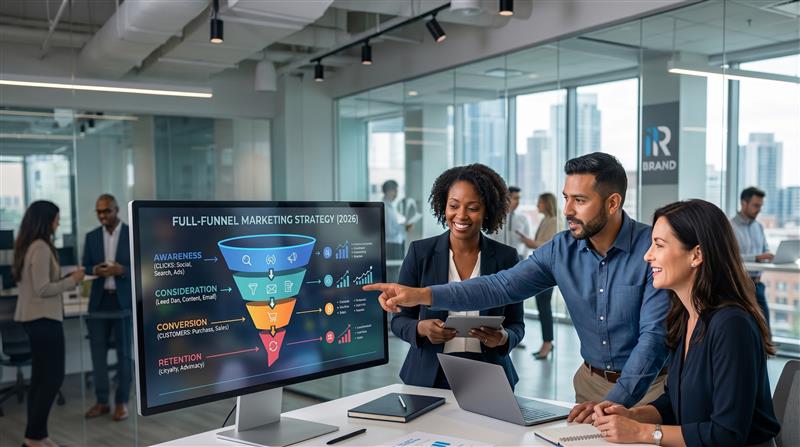
In the rapidly evolving digital landscape, simply driving clicks isn’t enough. For small and medium business owners, startup founders, and marketing managers, the true challenge lies in converting those clicks into loyal customers and demonstrable ROI. If your brand is running ads but struggling with conversions, 2026 demands a sophisticated yet streamlined approach: a robust full-funnel marketing strategy designed to guide prospects seamlessly from initial awareness to becoming advocates for your business.
Understanding the Full-Funnel Approach: More Than Just a Sales Pipeline
A full-funnel marketing strategy orchestrates every customer interaction, ensuring a cohesive journey from the very first touchpoint to conversion and beyond. It’s about strategically engaging your audience at each stage, addressing their unique needs and questions, and building trust that culminates in a booking, an audit request, or a qualified lead.
The Shifting Landscape: Why 2026 Demands a New Strategy
The marketing world of 2026 is influenced by advanced AI, increasing data privacy concerns, and an even more saturated digital space. Generic campaigns no longer cut through the noise. A full-funnel strategy, powered by data and personalization, is no longer a luxury but a necessity to achieve meaningful conversions and improve your marketing ROI.
Deconstructing the Full Funnel: Stages and Strategic Imperatives
Every successful conversion journey begins with understanding these critical stages:
Awareness: Grabbing Attention in a Noisy World
This is the top of your funnel, where the goal is to introduce your brand to potential customers who may not even know they have a problem your business can solve. For decision-makers and startup founders, this means establishing authority and relevance.
- SEO-Optimized Content Marketing: Blog posts, articles, and infographics that answer broad questions related to your industry.
- Strategic Social Media Engagement: Building brand presence and sharing valuable insights on platforms where your target audience spends time.
- Targeted Paid Advertising: Leveraging platforms like Google Ads and social media ads with broad targeting to introduce your brand.
Consideration: Nurturing Interest and Building Trust
Once prospects are aware, they move into the middle of the funnel, actively researching solutions. Here, marketing managers and business owners need to provide deeper value and build credibility.
- Educational Webinars & Workshops: Demonstrating expertise and offering actionable insights.
- Case Studies & Success Stories: Showcasing how your solutions have benefited similar businesses.
- Email Nurture Sequences: Delivering tailored content that addresses specific pain points and positions your brand as a solution.
- Retargeting Campaigns: Re-engaging website visitors with relevant ads based on their browsing behavior.
Conversion: Turning Interest into Action
At the bottom of the funnel, prospects are ready to make a decision. This is where brands already running ads but not getting conversions need to optimize heavily to secure the booking, audit, or lead.
- Optimized Landing Pages: Clear, concise, and compelling pages designed for a single call to action (e.g., “Book a Consultation,” “Request an Audit”).
- Irresistible Offers: Free trials, personalized demos, or exclusive consultations that minimize perceived risk.
- Direct Sales Engagements: For high-value leads, personalized outreach or a direct sales call can seal the deal.
Loyalty & Advocacy: Beyond the Sale for Sustained Growth
The funnel doesn’t end with a conversion. True full-funnel marketing extends to customer retention and encouraging advocacy, vital for long-term ROI.
- Exceptional Customer Service: Turning purchasers into loyal clients.
- Community Building: Engaging customers through exclusive groups or forums.
- Referral Programs: Incentivizing happy customers to spread the word.
Building Your 2026 Full-Funnel Marketing Strategy: Actionable Steps
To move from clicks to valuable customers, implement these strategic pillars:
Define Your Ideal Customer Profile (ICP) & Buyer Persona
Deeply understand who you are trying to reach. What are their pain points, goals, and preferred communication channels? This foundational step ensures all subsequent efforts are precisely targeted.
Map Content to Each Funnel Stage
Develop a content matrix that aligns specific content types (blogs, videos, case studies, demos) with each stage of the customer journey, addressing their evolving needs.
Leverage Data & AI for Personalization
Utilize analytics to track user behavior and AI tools to deliver highly personalized content and offers. This is crucial for optimizing your campaigns for marketing managers.
Integrate Your Tech Stack Seamlessly
Ensure your CRM, marketing automation platforms, and analytics tools communicate effectively. A unified view of customer data is essential for a seamless full-funnel experience.
Measure, Analyze, and Optimize Continuously
Regularly review key performance indicators (KPIs) at each funnel stage. Identify bottlenecks, test new approaches, and iteratively refine your strategy to maximize conversions and ROI.
Ready to transform your clicks into qualified leads, book more consultations, and request valuable audits? A well-executed full-funnel marketing strategy is your blueprint for success in 2026. Stop guessing and start converting.
Take the next step:Book a personalized consultation to assess your current strategy, or request a comprehensive audit of your marketing efforts today. Let’s build a funnel that truly delivers ROI.
