

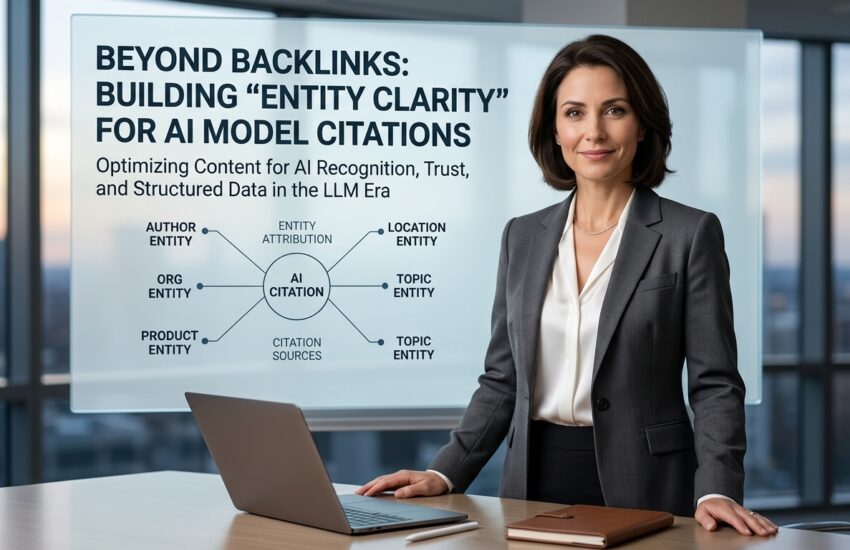
Beyond Backlinks: Building “Entity Clarity” for AI Model Citations
The Evolving Landscape of SEO in the AI Era
The foundational pillars of SEO are shifting. For decades, backlinks reigned supreme as a primary signal of authority and relevance. While still important, the advent of sophisticated AI models in search engines (like Google’s SGE, ChatGPT, and other LLMs) introduces a new, critical dimension: “Entity Clarity.” These AI systems don’t just count links; they seek to understand the world, its entities, and their relationships with unprecedented depth. For content creators and SEO professionals, this means a strategic pivot: ensuring AI can unequivocally identify, comprehend, and confidently cite your brand, products, services, and expertise. This isn’t just about ranking; it’s about becoming a recognized, trustworthy source in the AI-driven information ecosystem.
What is “Entity Clarity” and Why Does AI Crave It?
An “entity” is anything AI can uniquely identify: a person, an organization, a location, a product, a concept, or an event. Think of “Apple Inc.” versus “apple” (the fruit). AI needs absolute clarity to avoid ambiguity. “Entity Clarity” refers to how unambiguously and consistently an entity is presented across the web, making it easy for AI models to:
- Disambiguate: Distinguish between similarly named entities.
- Connect: Understand relationships between different entities (e.g., Apple Inc. is related to Tim Cook, iPhones, and Cupertino).
- Contextualize: Grasp the full meaning and significance of an entity within various contexts.
- Cite: Confidently attribute information, answers, and data to the correct, authoritative source.
Without entity clarity, AI struggles to build robust knowledge graphs, leading to misinterpretations, lack of citations, or even incorrect attributions – a significant blow to your digital presence and authority.
Strategic Pillars for Cultivating Entity Clarity
Consistent Entity Identification: Your Digital Passport
For AI to recognize an entity, its identity must be uniform wherever it appears. This involves:
- Standardized Naming: Use the exact same official name for your brand, products, or key personnel across all platforms (website, social media, press releases, business listings).
- Name, Address, Phone (NAP) Consistency: Crucial for local entities, ensuring your business’s NAP details are identical across Google Business Profile, directories, and your website.
- Unique Identifiers: Where applicable, leverage ISBNs for books, MPN/GTIN for products, or even Wikidata IDs for notable entities to provide explicit signals to AI.
Contextual Relevance and Semantic Networks: Building AI Understanding
AI learns by association. The context surrounding an entity helps AI models understand its nature and relevance.
- Semantic SEO: Move beyond keyword stuffing to creating comprehensive content that covers a topic exhaustively. Discuss related entities, concepts, and questions, building a rich semantic network around your core entities.
- Internal Linking: Strategically link to other relevant content on your site, using descriptive anchor text that includes entity names. This strengthens the internal knowledge graph of your website.
- External Linking (Strategic Outbound): Link to highly authoritative and relevant external sources when discussing related entities. This demonstrates responsible sourcing and helps AI validate the context.
Authoritative Content and E-E-A-T: Trust Signals for AI
AI models are trained on vast datasets and are increasingly adept at discerning authority and trustworthiness. Google’s E-E-A-T (Experience, Expertise, Authoritativeness, Trustworthiness) guidelines are more critical than ever.
- Showcase Expertise: Clearly identify authors with their credentials. Feature “about us” pages that detail your organization’s history, mission, and the expertise of your team.
- Evidence and Citations (Inbound): Ensure your content is well-researched and cites its sources. When external sites link to your content, it signals to AI that your entity is a valuable source.
- Reputation Management: Actively manage your online reputation. Positive reviews, mentions in reputable publications, and consistent positive sentiment contribute to an entity’s perceived trustworthiness by AI.
Structured Data and Knowledge Graphs: Speaking AI’s Language
Structured data, particularly Schema.org markup, is the most direct way to communicate entity information to AI models.
- Schema Markup: Implement relevant Schema types (e.g., `Organization`, `Person`, `Product`, `Article`, `LocalBusiness`) to explicitly define your entities and their properties. Use JSON-LD for ease of implementation.
- Knowledge Graph Optimization: By consistently applying structured data and building robust entity clarity, you increase the likelihood of your entities being included in major knowledge graphs (like Google’s). This is a powerful signal of recognition and authority.
- Wikidata Contributions: For highly notable entities, contributing to or ensuring accuracy on Wikidata can significantly boost entity clarity, as it’s a foundational data source for many AI systems.
Measuring and Monitoring Your Entity Clarity Footprint
While direct “entity clarity scores” don’t yet exist, you can infer your progress by:
- Monitoring AI Search Results: Observe if and how AI-powered search (e.g., SGE answers, LLM responses) attributes information to your brand or specific content. Are you cited as a source?
- Knowledge Panel Presence: For brands and notable individuals, the existence and accuracy of a Google Knowledge Panel is a strong indicator of entity recognition.
- Structured Data Testing Tools: Regularly use Google’s Rich Results Test and Schema Markup Validator to ensure your structured data is error-free and correctly implemented.
- Semantic Analysis Tools: Leverage tools that can analyze your content for entity recognition and topic coverage, highlighting areas for improvement.
- Brand Mentions: Track brand mentions across the web, paying attention to how your entity is referenced and if it’s consistently linked or attributed correctly.
The Future of Citations: Beyond the Blue Link
As AI models become more sophisticated, the concept of a “citation” will evolve. It may not always be a traditional hyperlink. AI could synthesize information from multiple sources and credit entities implicitly or explicitly in new ways (e.g., “According to [Your Brand]…”). The goal is to be the primary, unambiguous source that AI confidently draws upon. Building entity clarity now is a proactive step to future-proof your SEO strategy, ensuring your voice is heard and your expertise is recognized in the next generation of search.
Actionable Steps: Implementing Entity Clarity Today
- Conduct an Entity Audit: Map out all key entities associated with your brand (people, products, services, unique concepts).
- Standardize Your Digital Identity: Ensure consistent naming and NAP details across all online properties.
- Implement Comprehensive Schema Markup: Prioritize `Organization`, `Person`, `Product`, and `Article` types.
- Enhance Content Semantics: Create comprehensive content clusters that thoroughly cover topics and relate relevant entities.
- Strengthen E-E-A-T Signals: Clearly display author expertise, build out “about us” pages, and cultivate a positive online reputation.
- Monitor AI’s Recognition: Regularly check how AI search features cite or reference your brand and content.
- Educate Your Team: Ensure content creators, developers, and marketers understand the importance of entity clarity.
By embracing entity clarity, you move beyond the limitations of traditional SEO—positioning your brand as a trusted, authoritative source for the intelligent systems shaping the future of information discovery.
At Thought Hive, we help brands build strong digital identities that AI models can understand, trust, and cite. From entity-based SEO strategies to structured data optimization and full-funnel content planning, we ensure your brand stays visible in the evolving search landscape.
Let’s build your entity authority today.
Get in touch with Thought Hive
connect@thought-hive.com | +91 7356018708 | www.thought-hive.com |
